I recently caught up on Richelle Mead's Georgina Kincaid series (via audio-books) and I was surprised at how much I enjoyed them. I say I was surprised not because I avoid“chick lit” (far from it) or because I am not usually attracted to books where demons walks among us, but because I usually dislike the “hooker with a heart of gold” or “sadder but wiser girl” tropes. Therefore its was with a mixture of pleasure and annoyance that I realized I like Georgina Kincaid, a succubus who reluctantly serves “Team Hell” while trying, in her own way, to do the right thing.
Georgina has an obligation to her infernal masters to seduce and corrupt people with her sexuality, and she must “feed” off of mortals by taking part of their lives as they orgasm. Georgina is a bookstore manager, but in the past she has been both as stripper and a prostitute. She is still not shy about using her sexuality. Heroines who manipulate others and who frequently have sex with people they don't like are usually not ones that I admire, even if the author paints the heroine as both feeling guilty and acting sweet in proper measure. Somehow I still feel for Georgina.
The reluctant hero may not be all that uncommon, but the reluctant fan is probably relatively rare. It does happen though. After reading Deep Wizardry, Heinlein allegedly wrote author Diane Duane saying, "I'm a Navy man. We don't like sharks. You made me like that shark. That was a dirty trick." In a way, that's how I feel about finding how much I care about this succubus.
Despite my feelings about some of the the things that she does, I like Georgina. I'm a closet romantic of sorts. We usually don't like the“hooker with a heart of gold” spiel. Richelle Meed made me like this one. That was a dirty trick.
To be fair, my feelings on “using” others and commercialized sex have mellowed some over the years. I still think it's philosophically undesirable to encourage a mechanical and impersonal view of human sexuality, but I have started to feel the same way about the commercialization of sex as I do about the commercialization of Christmas. I'm not found of it, but people are going to do it anyway. Honestly, I worry more about other things I can't control because I have made some sort of emotional commitment to the outcome. For example, I was more upset about the cancellation of Caprica than I am about the continuing proliferation of pornography on the Internet. Honestly, I am still not over the cancellation of Firefly or the Dresden Files. Maybe this shows I accept that some things may be both commercialized and meaningful. I don't mind if people make money off of things I connect with, so long as the content providers do not mess with those aspects I consider sacred. For example, the prospect of making a Buffy reboot movie without Joss Whedon strikes me as an abomination. Next to such unnatural and clearly malevolent perversions as canceling my favorite shows or making heretical and no doubt watered-down copies of stories I love into crappy movies, the admittedly negative prospects of commercialized holidays and impersonal, mercenary views of sexuality seem rather unimportant. I guess I can accept the“bad” with the good so long as the bad does not outweigh the good. Also, what I really want is a good story. Everything else is relative to how much I like the story.
Georgina has a good story, even if she plays on some familiar patterns. She is a troubled and guilt-ridden succubus that way many popular vampires are reluctant and broody blood-suckers. She has a dark past. After one mistake that lead to a contract with Hell, she became an immortal servant of Satan. At first she fell into her new role in ways that she now feels damn her even more than the original sin (so to speak). When she is depressed she can fall back into destructive behaviors, but she is not beyond redemption. Her best friends may be vampires and imps, but she genuinely likes them and tries to protect them, even as she tries to protect the humans she has befriended. Also, she seems to have an angel in her corner, up to a point. Not bad for a daughter of Lilith.
Georgina's stories are interesting enough warrant attention and eventually loyalty as a fan. Richelle Mead's skill for creating complex characters and interesting plots are hard to resist. It helps that not only does Georgina try to do better than she has in the past, but she does not give up on love. It doesn't hurt that she has excellent taste in men―well not always, (she routinely sleeps with men who are already little sleazy so she won't feel guilty about shorting their lives when she feeds on them) but she has excellent taste in “true love”.
Though I enjoy the obstacles and conflicts Georgina must overcome when she tries to solve diabolical mysteries and save her fellow immortals, I'll admit that I like the main romance story in this case. The leading love interest, writer Seth Mortensen, pushes every book nerd button I have. There are certain common fantasies that never seem to go out of style. Teenagers daydream of going to concerts and having their pop idols look out into the crown, recognized a soul mate, and single the teen out for a personal connection. Middle-aged women fantasize about being mistaken for a woman half their age and being swept off their feet by (a) Johnny Depp or (b) a reasonable facsimile thereof. Loyal readers dream of meeting their favorite authors at a book signing and falling in love with the writer the way they fell in love with the books. If this were not true, women would stop sporting “Mrs. Gaiman” t-shirts at book clubs. Seth often looses himself in his writing and he expresses himself better in email than he does in person, which just makes me love this character more. He is the perfect sweet but introverted writer for any level of devotedly daydreaming reader.
The local demonic forces and their angelic counterparts are also fun and compelling at many levels. Though the local head angel and head demon hangout together and sometimes even work together, they both play their greater cosmic roles. Each immortal of any kind has a believable personality, but they are no better than they ought to be, not even the angels. Sometimes creatures from other mythologies make an appearance. Ultimately, this promises to be a story of love and redemption, but it is neither preachy nor simple. This is an entertaining series and well worth reading (or listening to).
Sunday, April 17, 2011

Monday, March 28, 2011
The Darrin Syndrome: When (Fictional) Love Makes Stupid Demands
In many ways 1960's and 70's sitcoms such as I Dream of Jeanie and Bewitched set the stage for the urban fantasy genre. There was one mortal and one magical partner, and the magical partner stove to act “normal” for the sake of love. There were a few situations when the magical partner was called on to act for the greater good, but the main theme of both shows involved the struggle of the supernatural partner to please by trying (and failing) to hide their true talents. Darrin from Bewitched was particularly adamant that his wife spend her day cooking and cleaning, and that she never use her power to benefit either one of them. Even though I was quite young when I watched Bewitched, I thought there was something extremely wrong with Darrin's reasoning. Every so often I still run across this theme in a subplot in an urban fantasy (or more likely in a plot of a paranormal romance) and I can't help but wonder why such a trope is still being used.
Generally speaking, a potential mate's special skills and abilities are one of the reasons a person is attractive. Can you imagine a woman marrying a profession basketball player, and then demanding that he give up sports and fame (and the money that comes with it), and instead work as a “normal” person in a some low-level clerical cubical for minimum wage? Did Melinda Gates demand that Bill give up business and computers (and their fortune), and instead work in construction so that he not stand out for his particular skills? Although one might see an argument for trying not to abuse magical powers or be outed in a society that may not understand those powers, it seems odd that so many urban fantasy and paranormal romance characters should try to insist that a magical person deny who they are in the name of love.
There are a few good reasons for writing characters who wants a supernatural partner to avoid certain aspects of their nature. For example, the recent popularity of vampire lovers leads to very necessary questions about vampire's killing people and the drinking blood (and these are usually dealt with by the vampire giving up killing and making other arrangements to feed). There are also times when the person with power feels such responsibility that they would themselves like to put it aside (as Buffy the Vampire Slayer was sometimes prone to do). Finally, the selfish use of power might be a turn off to those who don't want to play moll to a super villain. These all all legitimate reasons for star-crossing an interspecies paranormal romance. However, even in the age of the kick-ass heroine, magical people are often asked to give up magic simply because a human love interest is uncomfortable with it (though in modern stories the man is just as often asked to give up power for a female). Sometimes even when both partners are supernatural, the less powerful one demands the other start acting as if they don't have the extra advantages.
I wonder if this “Put your lover's light under a bushel” or Darrin Syndrome trope is some sort of literary application of the “ladder theory” of romance. According to the Ladder Theory, everyone ranks every potential partner in terms of the level of attraction, and trades up whenever possible. If this were the case, then in world where supernatural powers can add to the individual's rating, a mortal would do well to (a) snag someone more powerful and attractive than themselves and (b) do everything possible so that neither the higher ranked partner nor that partner's other potential mates realize that the magical partner could do better. Seen from this perspective, it gives our heroes and heroines poor self esteem and control issues.
Let's take a cynical view of the one of original trope sources: Bewitched. If Samantha Stevens hadn't spent all day vacuuming and dusting, then she may have realized that there were many hotter, richer warlocks who could offer much more than Darrin. She may even notice there are quite a few humans who would give a good looking young blond like her a maid and a nanny (and not ask questions such as "Where did the swimming pool come from?"). Maybe this is the point Endora was not so subtly trying to make when she objected to What's-His-Name. In many ways, Samantha's mother did Darrin a favor by throwing up opposition to the marriage. Samantha's desire to rebel may have stopped or overridden her own realization of Darrin's lower ranking. Then again, perhaps Samantha was so insecure that she married low enough to ensure he could never replace her with someone of higher ranking.
Perhaps it's best not to look too deeply into the motivation of fictional characters (especially not those in sitcoms). All the same, part of the fun of being a fan is identifying with or living vicariously through our favorite characters, so fans come to have certain expectations and opinions. Much can be forgiven in a good story, however, modern characters who fall prey to this trope are still perplexing. I will overlook brief and occasional outbreaks of the Darrin Syndrome in my favorite books or shows, but I will be secretly hoping they find a cure for it and soon.
Sunday, March 6, 2011
A Belated Defense of Twilight Fans
I sometimes feel the need to defend Twilight fans, though I don't defend the movies, or even the books. I take such pleasure in being an escapist fangirl of so many things that it is hard to see anyone else's relatively harmless pastimes become the designated whipping boy of large portions of the Internet (and society). In this, I reflect the sentiments of Randall Munroe's XKCD cartoon Aversion Fads.
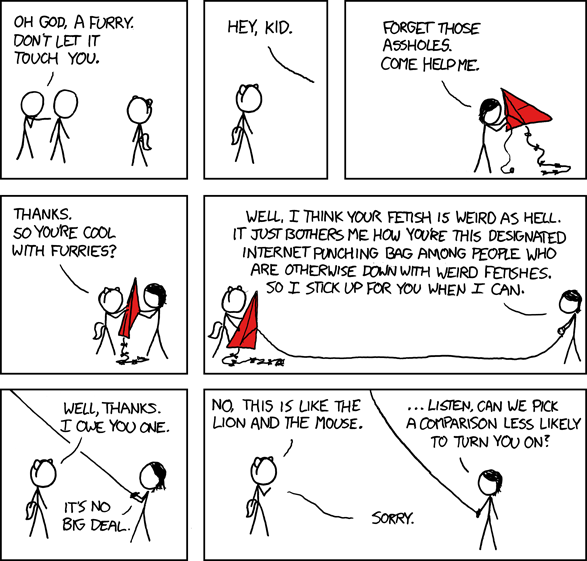
In the case of Twilight, I can understand the criticism of the works, but not the hatred of the fans.
Disclosure
Let me admit my personal biases. I prefer urban fantasy and sci fi to paranormal romance. Romance may add spice to a subplot, but I like complex and evolving main characters who are involved in either perpetrating or foiling a nefarious plot of cosmic proportions (and it doesn't hurt if ever so often something goes “bing'”or “bang”). I have read all of the Twilight books (I read a lot) but I could only sit through half of one Twilight movie. At first, I thought Twilight could be an interesting story despite some clunky moments if the reader used some imagination. As I kept reading, I was bothered by paternalistic and controlling nature of the main vampire, Edward Sparkle Pants, and the self-absorbed void of personality of the leading lady, Cinder Bella. I like strong female characters, so it annoyed me that Bella appears to care about nothing besides her True Love, which seems to be an outside force or curse of some kind rather than a choice on her part. By the final book, I was reading more to criticize the plot than to find out what happened. In this, I am a bit like the blogger from Mark Reads Twilight. I admit that I am opinionated and I am willing to complain about what I personally dislike even when it would be simpler to avoid it altogether.
Everyone is Entitled to Guilty Pleasures
The problem with moving from dislike of Twilight to dislike of Twilight fans is that in dumping on the easy target, we give the message that every little pleasure must conform to some group standard. This attitude discourages escapism, fantasy, and imagination, three things I embrace whenever possible. As long as no one gets hurt or used, people should be allowed to explore all manner of oddities and eccentricities. Fiction is a great way to do this. It may not always raise our collective consciousness, but somethings can be done just because a person wants to do them.
Tearing down other people's fun takes a bit of joy out of life and makes most of us hypocrites. There are some men, who I know for a fact enjoy fart jokes, who look down their suddenly superior noses at “Twilight moms”. There are people who spend vast quantities of time on YouTube watching videos of water skiing squirrels who will nonetheless sneer at those teens who sport a “Team Edward” shirt. Few can easily pull off acting as the epitome of maturity and culture without seeming simultaneously as if they have a large stick in an uncomfortable place. Admittedly, it may be that any number of fantasy books are the literary equivalent of bubble gum rock, but it may also be that sometimes, when no one else is there to see you, dancing to massed produced pop crap can be fun.
There are times to have fun. To be honest, most books I read are not chosen for intellectual challenges and insights into the human condition that shake my world-view. I pick books that capture my fancy for any number superficial or trivial reasons. In fact, if an author is trying to make some sort of point, it is probably necessary to drop several heavy anvils during the story in order to impact my thick head. I will not apologize for my harmless entertainment, and I don't think anyone else should have to either.
Live and Let Live
The human psyche is a weird and mysterious place. People should be encouraged to take their enjoyment as they find it. So I will defend Twilight fans in the same way I would stick up for furries, trainspotters and herpetologists. They are not hurting anyone; why not let them be? Anyone worth knowing has a few quirks and sometimes you have to embrace your inner dork. Any type of fandom is good if it enriches the life of the fan.
In the case of Twilight, I can understand the criticism of the works, but not the hatred of the fans.
Disclosure
Let me admit my personal biases. I prefer urban fantasy and sci fi to paranormal romance. Romance may add spice to a subplot, but I like complex and evolving main characters who are involved in either perpetrating or foiling a nefarious plot of cosmic proportions (and it doesn't hurt if ever so often something goes “bing'”or “bang”). I have read all of the Twilight books (I read a lot) but I could only sit through half of one Twilight movie. At first, I thought Twilight could be an interesting story despite some clunky moments if the reader used some imagination. As I kept reading, I was bothered by paternalistic and controlling nature of the main vampire, Edward Sparkle Pants, and the self-absorbed void of personality of the leading lady, Cinder Bella. I like strong female characters, so it annoyed me that Bella appears to care about nothing besides her True Love, which seems to be an outside force or curse of some kind rather than a choice on her part. By the final book, I was reading more to criticize the plot than to find out what happened. In this, I am a bit like the blogger from Mark Reads Twilight. I admit that I am opinionated and I am willing to complain about what I personally dislike even when it would be simpler to avoid it altogether.
Everyone is Entitled to Guilty Pleasures
The problem with moving from dislike of Twilight to dislike of Twilight fans is that in dumping on the easy target, we give the message that every little pleasure must conform to some group standard. This attitude discourages escapism, fantasy, and imagination, three things I embrace whenever possible. As long as no one gets hurt or used, people should be allowed to explore all manner of oddities and eccentricities. Fiction is a great way to do this. It may not always raise our collective consciousness, but somethings can be done just because a person wants to do them.
Tearing down other people's fun takes a bit of joy out of life and makes most of us hypocrites. There are some men, who I know for a fact enjoy fart jokes, who look down their suddenly superior noses at “Twilight moms”. There are people who spend vast quantities of time on YouTube watching videos of water skiing squirrels who will nonetheless sneer at those teens who sport a “Team Edward” shirt. Few can easily pull off acting as the epitome of maturity and culture without seeming simultaneously as if they have a large stick in an uncomfortable place. Admittedly, it may be that any number of fantasy books are the literary equivalent of bubble gum rock, but it may also be that sometimes, when no one else is there to see you, dancing to massed produced pop crap can be fun.
There are times to have fun. To be honest, most books I read are not chosen for intellectual challenges and insights into the human condition that shake my world-view. I pick books that capture my fancy for any number superficial or trivial reasons. In fact, if an author is trying to make some sort of point, it is probably necessary to drop several heavy anvils during the story in order to impact my thick head. I will not apologize for my harmless entertainment, and I don't think anyone else should have to either.
Live and Let Live
The human psyche is a weird and mysterious place. People should be encouraged to take their enjoyment as they find it. So I will defend Twilight fans in the same way I would stick up for furries, trainspotters and herpetologists. They are not hurting anyone; why not let them be? Anyone worth knowing has a few quirks and sometimes you have to embrace your inner dork. Any type of fandom is good if it enriches the life of the fan.
Monday, February 28, 2011
Pale Demon: Road Trip to Redemption
Rating: Five Burning Bunnies and a Box of Milk Dudes
Pale Demon by Kim Harrison is the ninth book of the Hollows series (released February 22, 2011, HarperCollins; ISBN: 0061138061). As a fan of the series, I have been anticipating this book for almost a year. I was not disappointed. I have read it three times so far, and I need to put it away so I can get back to work.
Pale Demon builds on the previous books. This book may not be the best stand-alone novel. I recommend that people start at the beginning of the Hollows series and read the books in order.
Pale Demon delvers fun and excitement with a satisfyingly level of character and relationship development. Fans of the series know the basic description of Rachel's wild road trip from the book's blurb. This review will have a sightly spoilery discussions of some of the major themes of the series.
Laws, Morality and Shades of Gray
In Pale Demon, Rachel notes that everyone makes sacrifices for what is important to them. She may have been thinking of how Jenks killed to protect his family and how Ivy killed to survive, but there are many more moral compromises in this book. Oliver breaks his word for what he sees as the greater good. Trent endangers innocent lives so that he can keep a promise (although he may have underestimated the danger at the time he made his choice). Rachel embraces her black magic powers because she sees it as necessary for survival.
Pale Demon demonstrates how what is legal is not always what is right. Oliver leads both the coven and the witch community with his view of strictly following the rules, even if circumstances are changing so that those rules no longer protect them. Rachel condemns Trent's use of illegal spells, but Trent justifies the compel and forget spells when his survival is threatened because the other option is to hurt or kill people. Rachel herself uses black magic again when it is the only way to stop a demon who is eating people. Rachel has been moving into shades of gray since the series began, and she continues to broaden her perspective.
In Pale Demon some characters see black magic as sometimes necessary in special cases (ends justifying the means). Others cannot let go of the idea of evil as a state of being (i.e. a demon must always be evil, therefore if a person can do demon magic, that person is evil). Still others accept that all magic is a tool, and that distinctions of "white" or "black" are not as important as how the magic is used. Many of the choices take place in an atmosphere of fear and desperation, but some characters act for love and to protect others. Survival and guiding the future take center stage for the Rachel and those closest to her
It's For the Children: What Parents Do to and for Their Young
Pale Demon continues the theme of parent-child relationships. Some make sacrifices to protect the young, and others manipulate their children to make them into better tools. A child can become a prize to be won or the face of redemption. Rachel sees her own mother's love again even as all other witches turn away from her, and also receives an oddly motherly tutelage from Newt. Newt regrets past mistakes made for the love of a child when she sees what that child has become. In revealing that demons are cursed by their mothers while in the womb in order to ensure their survival, Newt exposes the harsh conditions that may have come from war with the elves or from a power-driven "might makes right" society.
In the Hollows, saving the lives of the enemies' children seems to be a path for peace. Rachel's dad worked with Trent's dad because the elf saved Rachel's life. Trent comes to accept Rachel because she saved the elves' chance for future generations (and he becomes closer to her because she helps him to win his own daughter). Jenks accepts a fairy in his garden because she saved his children when he was away. Cooperation for mutual survival seems to offer a future that Rachel may embrace.
Dying children are a special concern in the series. Much of Rachel's character is formed in the “Make a Wish” camp where she was cured of a terminal condition. In parts of Pale Demon, Newt appears looking like one of the dying children Rachel knew from the Cancer Ward, and while Rachel is appalled, she sees that the form somehow fits Newt. Both elves and demons are on the brink of dying out, but each now have new hope. At some point each person in the book must face the question of what he or she would do for the survival of a child.
For the Shippers: How Many Nasty Little Men Do You Need?
Those readers who enjoy exploring Rachel's romantic options will love Pale Demon. This book has something for everyone, with the possible exception of Nick fans (are there still Nick fans?). In Pale Demon, Rachel kisses Al, Ivy, Pierce and Trent (though Trent's kiss may have had the most impact). She thinks of Kisten briefly (though he remains, alas, dead dead). She wishes she were small enough to hug Jenks, though there are no lusty thoughts involved. For a shunned witch, Rachel gets a lot of action. Of course nothing gets resolved, but we leave Rachel tingling with all sorts of possibilities.
Good natured shipper-wars can be fun, but it would be a mercy to some readers if at some point the major contestants will be limited to those characters we already know. Although I find these "dodecahedron of love" subplots to be entertaining, I hope there won't be many new love interests added in books to come. I have trouble keeping up with Rachel's current crop of hopefuls. In the interest of full disclosure, I was a Kisten fan, but I never warmed up to Pierce. Maybe I have an anti-new-guy bias, but I could see Trent or Ivy ending up with Rachel, or even Al or Jenks--just not someone new. Naturally Kim Harrison can and should do whatever she sees fit, because she does it so well. I just hope she gives all the main characters a satisfying happily ever after when and if she decides the series should come to an end.
Tuesday, February 22, 2011
Are Americans Really More Emo When Being Human?
I am giving SyFy's Being Human time to grow on me. It won't be easy to live up to the original Being Human from the UK. So far I'm bit disappointed with some aspects of the US show. At times it seems like it was hit too hard by the Twilight stick. All the same, I am hoping it will develop into something interesting. Unfortunately, I think the US show has a few obstacles to overcome before it can truly hit its stride.
The first hurdle the US show faces is with those viewers who are familiar with the UK Version. The best way to describe many reactions is what TVTropes refers to as “They changed. Now it sucks.” In interest of full disclosure, I am often critical of adaptations. I usually like the book better than the movie. I liked Buffy the Vampire Slayer better without Dawn (Buffy's little sister who was added to the show in Season 5). I prefer the animated Avatar: The Last Airbender to The Last Airbender movie. Although I am excited about the upcoming Torchwood (international version), part of me is afraid of what might happen to the show as they try to broaden its appeal.
On the other hand, some shows that change a good thing do manage to make their own mark. For example, I enjoy the dark comedy True Blood so much that I hardly ever point out the differences between Alan Ball's creation and the original Sookie Stackhouse Southern Vampire Mysteries. Showtime's Dexter is worth watching, even though the show is very different from the Dexter books. I love the urban fantasy genre, so I feel the more vampires, ghost and werewolves in mainstream media the better. If Being Human US can find it's own interesting twist on the original series without attempting to broaden it's appeal by lowering the quality, then I will give it my full fan girl support.
The second obstacle facing Being Human US is the deadly emo cloud that hangs over every episode. The angsty voice-overs may be meant to sound pithy, but they often come across as whiny. Part of the "woe is me" problem is the overall melodramatic style that sometimes drops on the viewer, but a larger part of it is the way the characters are presented. Dark is a good mood for a show about monsters, but we also have to be able to like monsters a little if we are going to embrace them as they try to be human.
Each of the main characters has room for improvement. The clean-cut hunky style vampire, Aiden ,seems too much like other popular US male vampire characters (Edward, Angel, Stefan) to pull off a good brood. When he tries it, he just seems superficially sulky or Lestat Lite. Sally, the ghost, has a reason to be sad, but we never fully see the caring or nurturing side of her character. Josh, the werewolf, is a lost puppy most of the time but he lacks adorkable appeal. Oddly, the most likable character at this point is the werewolf's sister, who is both fully human and minor to the plot.
It is a challenge to make each character fresh and have them show the good as well as the bad points of being supernatural. Hopefully the show will find a way to give the characters feeling and depth without keeping them all in unending self-absorbed agony. After all, they are monsters not teenagers. Even in the US, 20-somethings do grow up.
Each of the main characters has room for improvement. The clean-cut hunky style vampire, Aiden ,seems too much like other popular US male vampire characters (Edward, Angel, Stefan) to pull off a good brood. When he tries it, he just seems superficially sulky or Lestat Lite. Sally, the ghost, has a reason to be sad, but we never fully see the caring or nurturing side of her character. Josh, the werewolf, is a lost puppy most of the time but he lacks adorkable appeal. Oddly, the most likable character at this point is the werewolf's sister, who is both fully human and minor to the plot.
It is a challenge to make each character fresh and have them show the good as well as the bad points of being supernatural. Hopefully the show will find a way to give the characters feeling and depth without keeping them all in unending self-absorbed agony. After all, they are monsters not teenagers. Even in the US, 20-somethings do grow up.
The third issue facing the US Being Human is chemistry, or lack of it. The three main characters seem thrown together. At this point they are more like distant roommates than true friends. Each has their own story and each tries to show polite interest in the others. The feeling of genuine friendship is lost. They need to find more warmth and connection. If the characters don't really care about each other, it is harder to care about any of them.
The US Being Human needs more time to grow. The creators may find their own way to tell the story without feeling pressure to make the show “more marketable” based on generalizations about what Americans are supposed to want. It's true that nothing succeeds like success, but it is also true that mechanical imitations of things that are already popular tend to fall flat. Luckily, there are some good points to the US version of the show. I will keep watching to see what they do with it.
Sunday, February 20, 2011
A Guilty Goodbye to Borders
The local Borders is closing and it is (partially) my fault. Let me begin by admitting two things: (1) I enjoy browsing in books stores and (2) I am extremely cheap. I would regularly go to Borders to hang out. I like to touch and feel books, and preview the latest arrivals. I like the coffee and the comfy chairs. I like the people who work there. I like the free Wifi and company of book lovers. I rarely, however, bought books at Borders. I either buy the books for the cheapest price online or borrow them from a library or my friends. As a result I spent a lot of time at Borders but rarely spent much money there. Now that Borders is declaring bankruptcy and closing my local store, I will loose this friendly space to browse.
The doors of my doomed local bookstore have not yet closed, so I descended upon the soon to be unemployed clerks to get the 20-40% off final sales prices. I was not the only scavenger at the store. The place was packed. The lines were long. There was no coffee for sale, but at least we all finally bought something. Well, maybe everyone else was a regular customer. I finally bought books at Borders. Soon it will be gone (at least from my neighborhood). I sadly and guiltily wished the sales clerk luck in her job search as I checked out. And so, as they say, it goes.
I was thinking as I stood in line that if I were to suddenly find myself a billionaire, I could open a private nonprofit book club where people could come in, drink coffee, use the resources and meet for book-themed events. If the wisdom of the old TV show WKRP in Cincinnati can be trusted, I might even get a tax write off for my efforts if the place lost money. Then again, if I were to to suddenly find myself filthy stinking rich, I'd have a large private library in my new mansion, and a warehouse full of paperbacks. I would sit for hours alone with my piles of books, move them around with a fork lift and act like Scrooge McDuck in his money vault.
Perhaps it was penny pinching coffee bums like myself who pushed Borders into bankruptcy, or maybe they were too slow to understand the ebook market and other changing market factors. There are those who might say it's all come full circle, since big chain stores like Borders once drove many local mom and pop book stores out of business. Whether it's market forces or karma, I am not hurting too badly since I can still make it to the local library and to the comforts of Barnes and Nobel. So I give this last thought for my local Borders—thanks for being there. I will miss you.
Subscribe to:
Posts (Atom)